When To Visit an Emergency Dentist vs. an Emergency Room

When an unexpected dental concern arises, knowing whether to go to an emergency dentist or a hospital emergency room is key to finding the right care without unnecessary delays. A dentist can treat non-life-threatening dental issues that require urgent care, like sudden dental pain or a broken tooth. Meanwhile, a hospital is the right place to go for life-saving care, such as in the event of uncontrollable bleeding or a tooth infection accompanied by fever. Learning more about what each setting offers can help you feel more prepared for whichever one you need to visit.
When a dental issue needs immediate medical attention
Hospital emergency rooms (ERs) are the place to go when a dental issue is life-threatening. ER staff are equipped to work quickly to stabilize the patient. This is important for cases in which a dental issue is accompanied by:
- Severe respiratory distress
- Uncontrolled bleeding
- Major physical trauma
Some ways ER staff may stabilize a patient include controlling bleeding or managing an infection. They can also provide pain relief through medication. For life-saving care, call 911 or go directly to the ER.
How ER staff and emergency dentists work together
ER staff can stabilize a patient, but they are typically not equipped to perform actual dental procedures. For instance, a hospital rarely has the specialized tools needed to perform a root canal, place a permanent filling, or repair a broken crown. Once the medical threat is managed and the patient is discharged, the ER staff will likely refer them to a dentist to repair damaged teeth and gums.
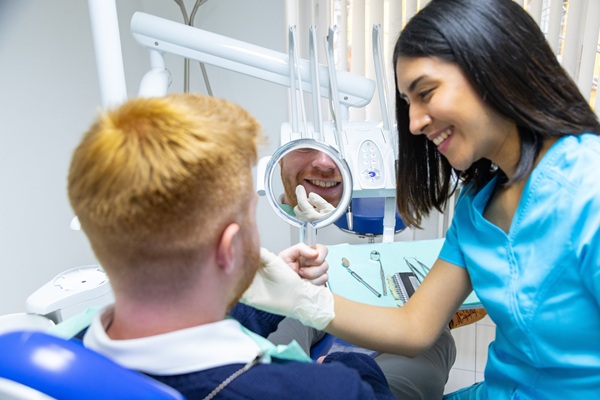
Dentists can find and treat the source of various dental issues. An emergency dentist, in particular, uses focused digital imaging and specialized exams to determine whether the issue could be a deep cavity, a cracked root, or a localized abscess, among others. Because the goal is to address the underlying cause of the pain rather than just managing symptoms, a dental visit is the most direct path to relief for most tooth-related problems after the initial concern is resolved.
When to go to an emergency dentist instead of the ER
An emergency dentist can handle urgent oral health concerns that are not life-threatening. A common example is a painful, throbbing toothache. This is often the result of decay reaching the nerve or an abscess forming at the root. A dentist can initiate treatment immediately to stop the pain at its source.
A knocked-out tooth is another issue that warrants immediate care from an emergency dentist. In fact, going to the dentist as soon as possible for this issue is of the utmost importance: There is a much higher chance of reimplanting the tooth if the patient makes it to the dentist within the hour.
Other reasons to see an emergency dentist include:
- A dental restoration, like a crown, fell out or broke
- A cracked or chipped tooth
- Painful swelling around a tooth
An emergency dentist usually sets aside same-day or next-day appointments to accommodate patients with urgent needs. For best results, find a dentist who offers urgent services ahead of time. Knowing exactly who to call and where to go in the event of a dental emergency means accessing effective care and pain relief sooner.
Looking for an emergency dentist?
An emergency dentist is the right provider for urgent dental care. However, if the issue is life-threatening, visit a hospital emergency room first. For urgent dental care in Carol Stream, reach out to Stratus Dental Studio today.
Request an appointment here: https://www.stratusdentalstudio.com or call Stratus Dental Studio at (630) 517-4304 for an appointment in our Carol Stream office.
Check out what others are saying about our dental services on Yelp: Emergency Dentist in Carol Stream, IL.
Related Posts
When dentures break, patients may have difficulty with daily activities, such as speaking and eating. Do not wait until your next regular dental appointment to address this issue. If you cannot be seen in a timely manner, an emergency dentist can help patients restore their dentures as quickly as possible.Dentures are usually durable but do…
If you have an abscessed tooth, then a visit to an emergency dentist is important for you. An abscessed tooth is caused by a bacterial infection that causes a pocket of pus to form in different parts of the tooth. This can lead to medium to strong pain that can radiate from the ear to…
Emergency dentistry is a branch of dentistry that focuses mainly on addressing issues that require urgent treatment. A regular dental appointment might require you to wait one or two weeks for the next open slot on your dentist’s schedule. That is not an option when dealing with dental issues that cause excruciating pain, bleeding or…
Even though dentistry consists of many different services, you might be surprised to learn that many of them are performed by a general dentist. While certain specialists handle certain procedures, a regular dentist takes care of many of the more common or popular services.We have put together our list of the top 5 services offered…